
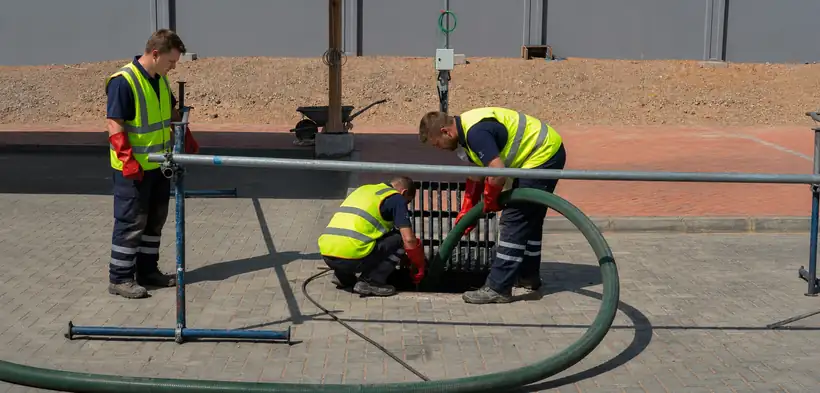
Villa owners worry about their gullies; owners associations and facility teams inherit something bigger: kilometres of road drainage, dozens or hundreds of catch basins, collector lines, and culverts under the roads, all of it invisible, all of it silting quietly, and all of it judged in public on the day of the first big storm. This is the community scale view.
The network you are responsible for
A typical community storm system runs in one direction: road gullies and catch basins collect surface water, collector lines carry it, culverts take it under roads and landscaping, and the whole flow exits at outfalls or soakaways. Every stage is designed with sediment in mind, which is exactly why every stage needs emptying: the basins trap sand on purpose, and the lines and culverts collect what gets past them. As a working rule, drainage inside the community boundary is typically the community responsibility, while public roads sit with the authorities; the boundary is worth confirming in your own documents.
Why communities flood
- Catch basins fill with sand across a dry year until a storm finds no capacity left
- Collector lines silt gradually and shrink exactly when full flow is needed
- A single blocked culvert dams water across an entire road or access point
- Known low spots pond first, and nobody owned the list of where they are
- The budget conversation happened after the storm instead of before it
The annual program
The communities that stay dry run the same boring loop. An inventory: know every basin, line and culvert, on a map, with the known ponding spots marked. A pre season clean: basins emptied, collectors jetted, culverts cleared, timed for autumn before the rains. A post storm inspection: after any major rain or sandstorm, check the network while the evidence is fresh. And records: every visit documented, so the OA board sees where the money went and the next facility manager inherits a file, not folklore.
Prioritising with a limited budget
If the budget does not cover everything annually, priority is not a mystery: the known ponding locations first, the culverts second, because a blocked culvert has the largest single failure footprint, then the basins on the main access routes. A camera survey of the collector lines every few years tells you whether silt is winning and where, which turns budget requests into evidence rather than opinion.
The budget conversation, honestly
Storm maintenance is a predictable annual number. Storm failure is an unpredictable large one: emergency call outs at storm rates, damaged landscaping and assets, flooded parking, and residents documenting it all in the community group. Boards rarely regret the scheduled version. The program is what being ahead of that conversation looks like.
- Community storm systems flow one way: basins collect, lines carry, culverts cross, outfalls release; every stage traps sediment by design.
- Communities flood on dry year neglect: full basins, silted lines, and one blocked culvert can dam a whole road.
- The program is an inventory, a pre season clean, post storm inspections, and records the board can see.
- On a limited budget: known ponding spots first, culverts second, main access basins third.
Want your community ready before the rain?
Free quote before we start. Same day service across Dubai.
Frequently asked questions
When should a community schedule its storm maintenance?
Before the season, typically in the autumn, with inspections after any major storm or sandstorm. Communities that wait for the forecast join the same queue as everyone else, usually behind the storm itself.
Who is responsible for which drainage in a community?
As a working rule, everything inside the community boundary, internal roads, parks, basins and culverts, is typically the OA or master community responsibility, while public roads outside it sit with the authorities. Confirm the exact boundary in your community documents; knowing it before a flood is far better than debating it during one.
Can you map our network if we have no records?
Yes. An inventory visit locates and logs the basins, lines and culverts, and a camera survey of the collectors establishes their condition. That map becomes the basis of the program and outlives any individual manager.